
By Charley Stevenson
🔊 Listen to thIS story
3 min. 56 sec.
Why Perfection Hinders Progress
Even the most ambitious projects today never achieve what anyone would call perfection. A building that measures 20% Red List Free—the avoidance of chemicals considered “worst in class” for human and environmental health—may actually sit at the leading edge of what’s possible. That’s not failure—it’s context. Progress in the built environment is evolutionary, not absolute.
Learning from History: The Clean Air Act Example
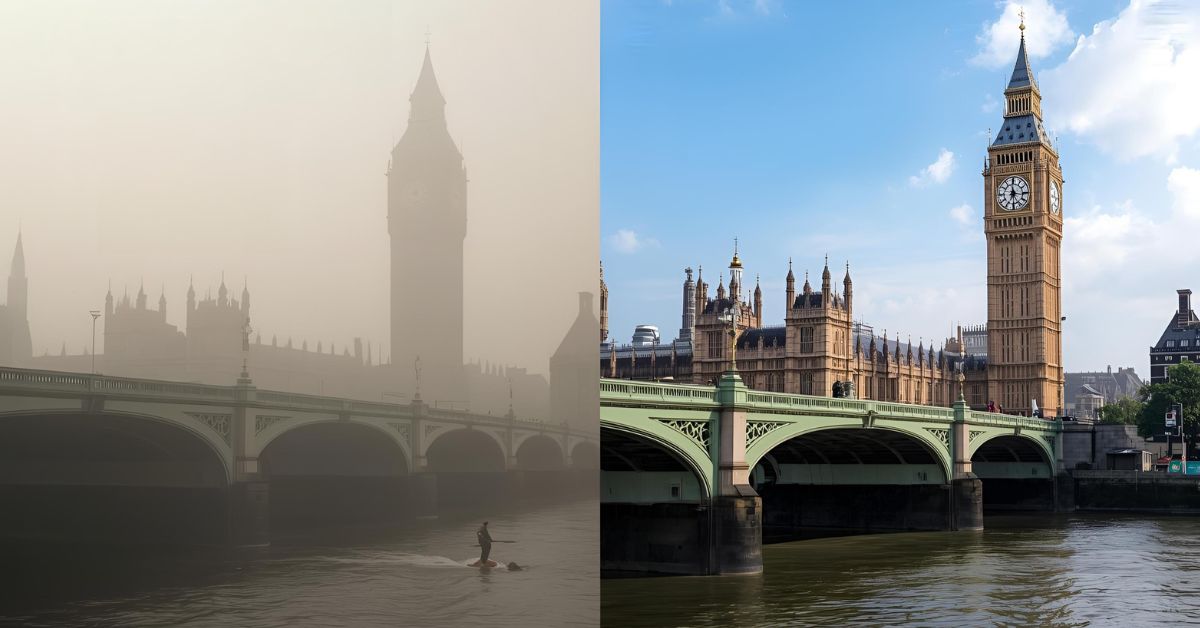
History gives us perspective on this. In the mid-20th century, London was suffocating under coal smoke. The infamous Great Smog of 1952 killed thousands and spurred a national reckoning—an event dramatized for millions of viewers in The Crown (Season 1, Episode 4, “Act of God”). The series captured how the deadly haze paralyzed the city, exposed political hesitation, and ultimately pushed momentum toward reform. Out of that crisis came the UK’s Clean Air Act of 1956, which forced changes to fireplaces, restricted smoke from chimneys, and dramatically improved air quality. Part of the solution was a shift to natural gas—at the time a huge improvement. The air cleared, respiratory disease rates dropped, and London became livable again.
The Evolution of Environmental Solutions
Science is never static; it’s an ongoing practice of inquiry that continually reshapes what we understand as progress. Today, we know that natural gas—once hailed as the cleaner option—carries its own set of concerns. Combustion releases nitrogen dioxide and carbon monoxide that cause concerns for air quality. Research now links gas stoves and heaters to increased asthma rates, especially in children. And methane leaks across the supply chain make natural gas a major contributor to climate change.
Does that mean the earlier progress was wrong? No. It means it was the best step possible with the knowledge and tools available at the time. Perfection, then as now, is not only unattainable—it’s variable. What looks perfect in one moment can become problematic in the next. If we wait for perfection before acting, we risk freezing—like the human stress response of fight, flight, or freeze. Waiting guarantees paralysis, and paralysis guarantees no improvement at all.
Adaptive Sustainability: Moving Forward with Confidence
What we focus on is momentum: the small, continuous steps that carry us toward a future that thrives. We’re not here to judge past choices or scold today’s limitations. We’re here to reflect the state of the market, highlight where better options exist, and guide teams toward continuous improvement. Swap an adhesive for a fastener. Choose a healthier coating. Select a flooring option that nudges your project forward.
Over time, those small steps accumulate into patterns that reshape the market. And when science evolves—as it always does—we’ll adapt again. That’s how sustainability moves: not by waiting for a finish line of perfection, but by walking the path of progress, one decision at a time.
Reference Sources:
- Brimblecombe, Peter. The Big Smoke: A History of Air Pollution in London Since Medieval Times. Methuen, 1987.
- Seals, Brady A., and Krasner, Andee. Health Effects from Gas Stove Pollution. Rocky Mountain Institute, 2020.
- Intergovernmental Panel on Climate Change (IPCC). Climate Change 2021: The Physical Science Basis. Cambridge University Press, 2021.
Charley Stevenson, LFA, LEED AP, Founder. With the Materially Better team, Charley has developed processes and software to integrate better materials selections into all project types and to transform the market as quickly and easily as possible.
